Stop Booking Around the Monsoon: Thailand's Wet Season Is the Trip You're Too Chicken to Take
Book a Thailand trip for July and someone in your group chat sends the crying-laughing emoji. Book for October and somebody's mom forwards you a flood video with the caption, is this where you're going. Book in the golden December-to-February window and you'll pay double to stand shoulder to shoulder with eleven thousand other Americans who ran the exact same math.
Meanwhile your weather app shows one sad cloud over a country the size of Texas and calls it a forecast.
Here is the part the booking engines won't say out loud: the wet season isn't a defect in the product. It's the product. If you can survive a wet sock and a rewritten itinerary, the monsoon months hand you the cheapest, greenest, quietest, strangest Thailand you will ever get — and the one where you actually feel like you're in a country instead of a queue.
Your Weather App Is Lying to You by Being Honest
Thai rain doesn't behave like American rain. It isn't Portland drizzle that ruins a whole afternoon of being mildly damp. It's a 45-minute drum solo on a tin roof, then a pause, then steam lifting off the asphalt like the street is exhaling, then sun so bright it hurtles you straight back into sunscreen territory.
What that means practically: a 60 percent chance of rain does not mean a lost day. It means a lost hour, at a time you cannot predict. So plan mornings hard, leave afternoons loose, and stop treating a 3 p.m. radar blob like it's a verdict from God. Nobody in Bangkok checks the hourly forecast. They check the sky and move.
What 'Flooded Street' Actually Means
When Thais say a soi is flooded, they usually mean one to three inches of warm water sitting over asphalt for a couple hours. When a foreigner hears flooded, they picture a CNN chyron.
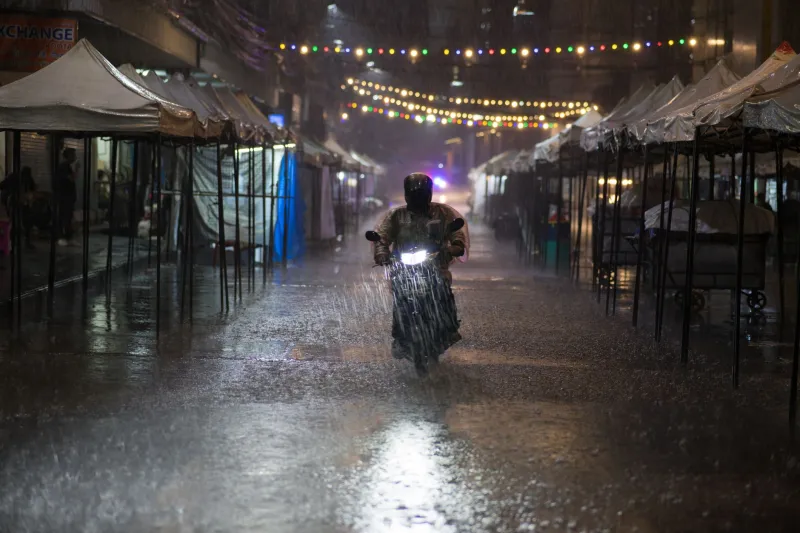
Bangkok drains badly in a downpour and beautifully about ninety minutes later. Motorcycle taxis turn into amphibious vehicles. Curbs vanish, sandals give up, and the city offers you the world's most humid Slip 'N Slide. In the north, rivers can genuinely swell and hill-country roads can wash out. On the islands, it looks less like catastrophe and more like a lake where the beach was.
What actually happens: a walk becomes a two-minute moto ride for about a buck fifty. Grab still runs. Every 7-Eleven in the kingdom sells a poncho for less than your airport coffee. The correct response is not panic. It's a dry bag and a slightly better attitude than the guy yelling at the front desk.
The Ferry Problem Is Real, So Plan Like an Adult
This is where the wet season genuinely bites, and it's the reason the season has its reputation.
On the Gulf side — Koh Samui, Koh Phangan, Koh Tao — the rough window runs roughly November into December, when the northeast monsoon turns the crossing into a rodeo and speedboats get grounded. On the Andaman side — Phuket, Krabi, Phi Phi, the Similans — the hammering lands May through October, and the national park islands close seasonally on a schedule you should look up before you fall in love with a photo.
So: never book a flight home the same day as your island return. Give yourself two buffer nights. Fly instead of ferry when the forecast is ugly and eat the cost as the price of not becoming a viral airport-floor video. And book the boat through an operator who says the phrase weather permitting and means it.
Insurance: Read It Like It Owes You Money
The single most expensive mistake Americans make in monsoon season is assuming travel insurance covers weather. A lot of it does, in the same way a gym membership covers fitness.
Three things to actually check before you pay:
- Adverse weather exclusions. Plenty of cheap policies exclude weather-related cancellations and then sell you the fix as an upgrade.
- Trip delay versus trip interruption. Delay pays for your hotel and meals after a set number of hours. Interruption pays to get you home or reroute you. They are not the same word, and the difference is four figures.
- Common carrier definitions. A ferry that isn't a licensed common carrier may not count. That sunset longtail you booked on WhatsApp is a beautiful memory, not a covered event.
Buy within the first two weeks of your first booking — the cancel-for-any-reason add-on is usually only available early, and it costs a lot. It is also the only clause that doesn't care why your trip fell apart.
Hotel Refund Policies Are Written by People Who Pray You Don't Read Them
Nonrefundable means nonrefundable, and arguing at a Bangkok front desk in wet shorts has never once moved money. What does move money is a paper trail.
Book direct when you can and ask one written question: what happens to my deposit if the ferries stop running. You'd be surprised how many small resorts in low season will say something flexible in an email and then honor it. You'd also be surprised how many booking-platform rates quietly bury a no-show clause that eats your entire stay.
For island hopping in the wet months, book the first two nights and the last two nights and leave the middle soft. Low season is the one time of year you can wing it in Thailand without sleeping on a beach. Use that.
How Locals Actually Move Through the Wet Months
Watch and copy.
Nobody carries an umbrella they love. The cheap folding one lives in the bike basket and gets replaced without ceremony. Laundry gets timed to the sky, not to the calendar. Shoes come off at the door and stay off. A whole neighborhood will sit under a corrugated awning for twenty minutes, eating noodles, waiting out a squall, and not one person will treat it as a crisis.
The famous mai pen rai isn't fatalism. It's logistics. You cannot fight weather. You can only be somewhere dry when it arrives.
Why the Rain Actually Wins
Because water is the whole point of this country and you've been visiting it dehydrated.
Rainfall is what turns Erawan and Sai Yok into the seven-tiered green monsters you've seen on someone else's grid. It's why the rice terraces in the north go electric. It's why the islands in green season look like something out of a fever dream instead of a slightly dusty postcard. A monsoon squall rolling across the Gulf — purple wall, white line, five minutes of total noise — beats any fire show on any beach.
And the boring advantages are the ones that change a trip: hotel rates down a third to half, temples you can hear yourself think in, boats that aren't packed, restaurants that don't need a reservation, and a country that isn't running a customer service performance for a million simultaneous arrivals.
The Packing List Nobody Hands You
A dry bag. Quick-dry everything. Two pairs of sandals, one of which must survive total submersion. A rain shell you would not grieve if you left it in a taxi. Ziplocks for your passport and your electronics. Anti-fungal powder, because you are an adult. And zero loyalty to any plan made more than 24 hours ago.
That last item is the whole philosophy. The rainy season doesn't hand you a postcard. It hands you a country that is actually alive, that shrugs at its own weather and gets on with lunch. Which is, if you think about it, the exact thing you flew eleven time zones to see.