Fists, Sweat, and Something You Can't Quite Name: Americans Are Getting Wrecked by Muay Thai — And They Keep Coming Back
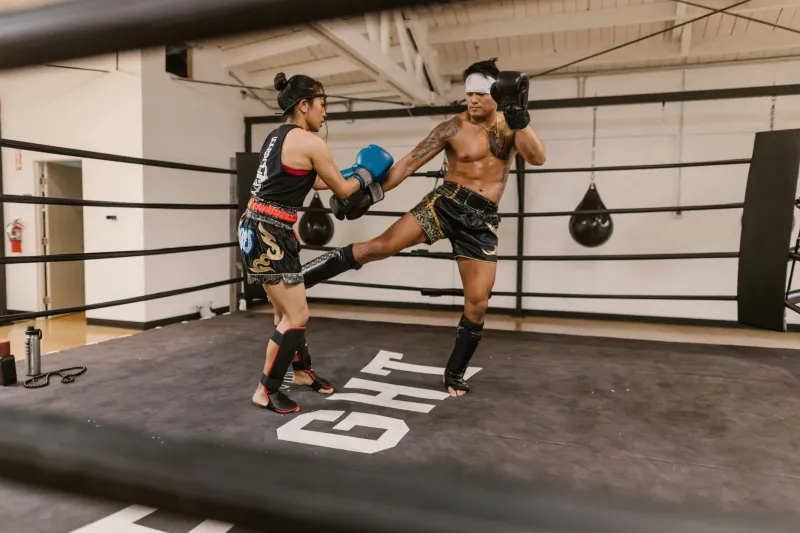
It's 6 a.m. in a concrete gym somewhere outside Chiang Mai, and the air already smells like Tiger Balm and dried sweat. A 28-year-old from Portland named Jake is running pad drills with a Thai trainer who looks like he weighs 140 pounds and could probably dismantle a pickup truck with his shins. Jake is bigger, stronger, and approximately three years behind.
By 8 a.m., he will have taken an elbow to the cheekbone, thrown up once behind the gym, and felt something he describes — with complete sincerity — as "the closest thing to enlightenment I've ever experienced."
This is the Muay Thai pull. And it's dragging Americans across the Pacific in growing numbers.
What's Actually Drawing Americans to the Mats
Muay Thai — the "Art of Eight Limbs" — has been Thailand's national sport and martial heritage for centuries. What most Americans know of it comes from UFC highlight reels and kickboxing classes at their local gym. What they find when they actually get to Thailand is something categorically different.
The training is brutal by Western fitness standards. Sessions run two to three hours, twice a day. Pad work, bag work, clinch work, sparring. The diet is monitored. The sleep is non-negotiable. And the technical demands — the precise mechanics of a teep kick, the geometry of a clinch, the timing of a counter — take years to genuinely absorb.
"I thought I was in shape," says Derek, a 31-year-old software engineer from Denver who came to Thailand on a two-week vacation and stayed for eight months. "I ran half-marathons. I did CrossFit. My first week at the camp, I couldn't finish a single session. I was humiliated and completely hooked."
That paradox — humiliation as hook — shows up in nearly every American Muay Thai story. There's something about being genuinely, undeniably bad at something that strips away the performance anxiety of modern American life. You're not networking. You're not optimizing. You're just trying to not get kicked in the face.
The Informal Camp Circuit: Off the Tourist Map
Thailand has a well-developed ecosystem of tourist-friendly Muay Thai camps — professional operations in Phuket and Bangkok with English-speaking trainers, air-conditioned rooms, and Instagram-ready facilities. These are great. They're also not the full picture.
Beyond the polished camps lies a network of smaller, less formal gyms where actual Thai fighters train. These aren't secret, exactly — locals know them, and word spreads through expat communities — but they're not advertising on Google either. The trainers may speak limited English. The facilities are basic. The sparring is not adjusted for tourist sensibilities.
"At the tourist camps, they'll go easy on you," explains Kru Somchai, a retired fighter who now trains at a small gym in Isan. "At a real camp, the Thai boys will test you. Not to hurt you — to see if you're serious. If you are, they'll teach you things you won't learn anywhere else."
Americans who find their way into these spaces describe a steep and occasionally painful cultural learning curve. Hierarchy matters enormously. You don't correct your trainer. You don't show off. You show up, you work, you shut up. For a lot of Americans, that's a harder adjustment than the physical training.
The Injuries Nobody Posts About
Let's be honest about this part. Muay Thai training — real Muay Thai training — involves a non-trivial injury rate. Shin splints, stress fractures, torn ligaments, concussions, and the specific misery of a blocked kick landing on an unconditioned forearm are all part of the curriculum.
The informal fight scene carries additional risks. Underground bouts — organized fights outside the regulated stadium system — operate in legal gray areas. Medical oversight varies. Weight matching can be approximate.
"I fought at a village event that was basically organized in a field," says Tommy, a 26-year-old from Chicago who's been in Thailand for two years. "The crowd was incredible, the experience was incredible. I also took a knee to the body that kept me out of training for three weeks. No regrets, but I went in knowing the deal."
The deal being: you're not in a sanctioned bout at Madison Square Garden. You're in Thailand, in a field, fighting someone who has been doing this since he was eight years old. Adjust your expectations accordingly.
The Cultural Friction That Nobody Warns You About
Muay Thai is not just a sport in Thailand. It's woven into spiritual practice, regional identity, and national pride. Fighters perform the Wai Kru Ram Muay — a pre-fight ritual that honors teachers, family, and the sacred — before every bout. The mongkol (headband) and prajioud (armbands) carry genuine spiritual significance.
When Americans show up and treat the whole thing as an extreme fitness trend or a bucket-list adventure, it creates friction that's rarely acknowledged openly but is absolutely felt.
"Some of the foreigners treat it like a CrossFit class with more punching," says one trainer at a Chiang Mai camp who asked to remain anonymous. "They want the certificate, the photos, the story to tell at home. That's fine — but they're missing everything."
The Americans who stick around longest, who earn genuine respect in Thai gyms, tend to be the ones who approach the sport with something approaching reverence. Who learn the rituals. Who study the history. Who understand they're guests inside something ancient.
Why They Keep Coming Back
Ask the Americans who've done this — really done it, not the three-day tourist package — why they keep returning, and the answers start to sound less like travel testimonials and more like something else entirely.
"It changed how I move through the world," says Derek, the Denver software engineer. "Not because I can fight. Because I learned what it feels like to be genuinely bad at something and keep going anyway. Thailand handed me that."
The gyms are still there. The trainers are still waiting. The 6 a.m. alarm is still brutal.
And somewhere outside Chiang Mai, Jake from Portland is lacing up his gloves again.