The Room They Don't Rent: A Field Guide to Thailand's Ghosts Before You Check In
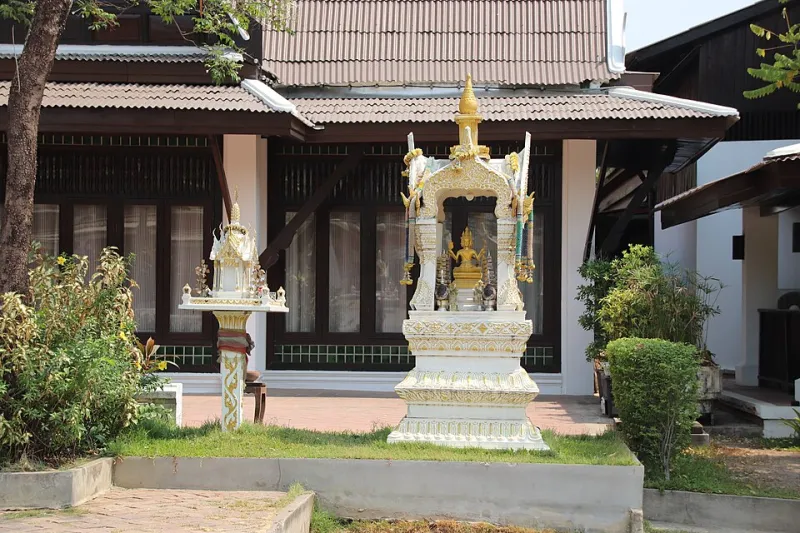
Photo: Gary Todd from Xinzheng, China, Public domain, via Wikimedia Commons
Every traveler to Thailand eventually notices the little houses. They're everywhere — outside malls, in hotel parking lots, on the corner of restaurant properties — tiny ornate shrines with offerings piled in front: strawberry Fanta, red Fanta specifically, flowers, incense. If you ask what they are, a Thai person will tell you plainly: they're spirit houses, homes for the ghosts who were here before you. You give them a place to live and something sweet to drink so they don't come inside.
This is not a quaint superstition to Thai people. It's property management. And it's the cultural context you need before you read a single one-star review that says 'strange presence in Room 214.'
The Widow Ghost of the Northeast
Start in Isan, Thailand's rural Northeast, where belief in the Mae Nak tradition and its cousins runs deepest. The most famous is the legend of Mae Nak Phra Khanong — a woman who died in childbirth but whose ghost continued living with her husband, cooking and caring for him, until he discovered the truth and fled to a temple. It's one of the most famous ghost stories in the country, adapted into dozens of films, and it's not really a horror story. It's a love story that went wrong. That's the key to Thai ghosts: most of them aren't evil. They're attached. Grief made them stay.
Then there's the Phi Pop, a spirit that — per folklore — inhabits a person and feeds on the internal organs of others, and the regional widow ghost (Phi Maew), said to target men traveling alone. In parts of the Northeast, some men traditionally avoided certain roads at night. Call it superstition if you want, but the belief shaped real behavior for generations.
Why Some Hotel Rooms Stay Empty
Now, the practical part. Thailand has a robust hospitality industry and an equally robust relationship with the spirit world, and sometimes those two things collide. Hotel owners — particularly outside the big international chains — take reported hauntings seriously. Monks are brought in. Blessing ceremonies happen. And occasionally, a room is quietly taken off the booking system.
Regulars know to look for the signs: a room number that skips in the elevator, a small shrine tucked into a hallway corner, a floor that's oddly unbooked during high season. Is every skipped number a haunted room? Of course not. Sometimes 13 just doesn't sell. But talk to staff at older beachside resorts and the stories come out after the second drink — the guest who checked out at 3 a.m. without showering, the housekeeper who refuses to clean one particular room alone.
Reading the Reviews Like a Local
American travelers tend to filter hotel reviews for bedbugs and bad Wi-Fi. Locals read differently. A review saying 'my child kept pointing at the corner and crying' gets taken at face value in Thai culture — children are traditionally believed to be more sensitive to spirits. So is 'the room felt heavy.' These aren't red flags for dirtiness. They're, depending on your belief system, either atmospheric or literal warnings.
The good news: Thai culture has an entire toolkit for this, and it's tourist-friendly. Wai kru, spirit houses, amulets from temples, monks who perform blessings on request. If you're the nervous type, staying at a property with a well-maintained spirit house is arguably the single most reassuring detail you can check. It means the management handles their ghost relations.
The Takeaway for the Beach-Bound
Look, the odds you encounter anything stranger than a gecko in your hotel room are vanishingly small. Thailand's beaches are safe, its resorts are lovely, and most ghosts in the cultural imagination are just people who died with unfinished business — which, if you think about it, describes most hotel guests too.
But when you pass that little shrine in the parking lot and see the bottle of red Fanta, don't laugh. Leave the ghost his soda. It costs nothing, it means something to the people whose country you're visiting, and if even one percent of the folklore is true — well, you're going to want to be on good terms with the neighbors.